Empty Envelope
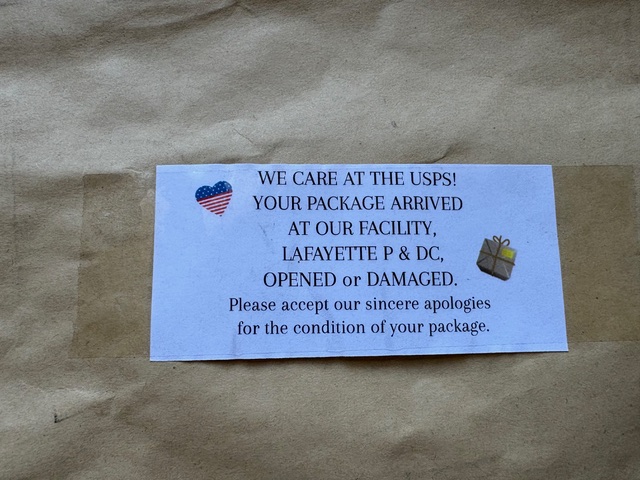
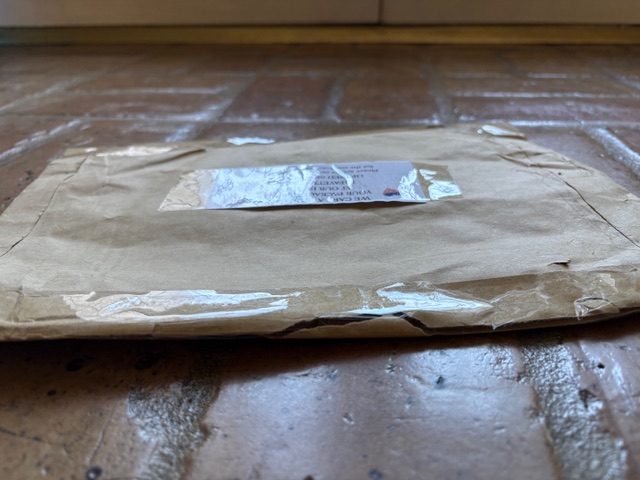
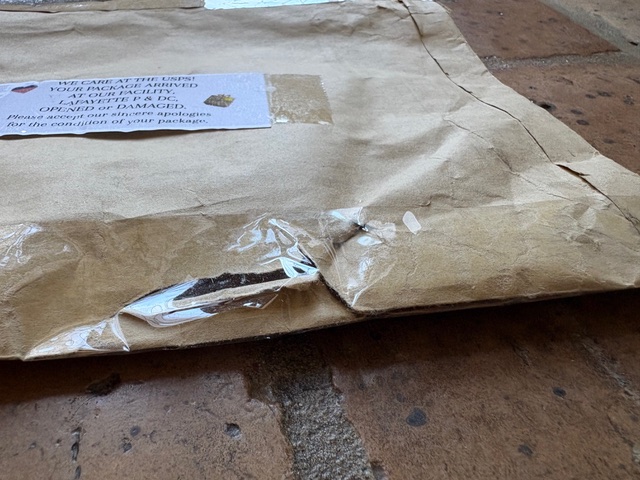
These photos reveal how the package from Sage arrived:

Cost-Conscious Audiobook Options
Someone asked me about audiobook options recently. I have been a paid subscriber to Audible in the past, both before and after its acquisition by Amazon, and I have also listened to audiobooks on Spotify and via Libby. (And there have been more than a few podcasts that ended up being audiobooks via long-form audio theater — is that how to describe what used to be radio theater?)
Doing a bit of spelunking on the web, and polling a few people, I came up with the following:
Free Options
Your local public library remains the best way to listen to audiobooks at little to no cost. I am listing Libby here, but there is also CloudLibrary. I have used Libby and really liked it. I have used CloudLibrary and really not liked it: the app seems to need to refresh itself every time you open it and the selection available, at least through my public library in the south, is very limited. There is also LibriVox / Project Gutenberg which offer free audio recordings of public-domain classics (like Pride and Prejudice or Sherlock Holmes), but I have not checked them for production quality.
Low-Cost Subscription & Rental Models
If your library doesn’t have what you want, the lower-cost paid routes include Audible Plus, Spotify Premium, and Everand. As I noted at the top of these listings, I have been an Audible subscriber and I developed a fairly good catalog during that time. I no longer am a premium subscriber, but I keep my eyes open for intermittent sales, where I often pick up a book or two for $5-$8 each. I have had Spotify Premium, and its audiobook listening model is fundamentally broken: it only allows the account owner access to audiobooks and it has a randomly chosen cut-off point of 15 hours. (It was 10 when I degraded my subscription to remove the “free” audiobook option.) A sensible unit would be one book. Maybe that book is 8 hours; maybe it’s 16 hours. I’m pretty sure it would average out. Either way, you would not find yourself in the middle of a long-drive and the novel you started coming to a sudden stop.
Low-Cost Purchases
If you prefer to keep your audiobooks forever but don’t want to pay retail prices:
- Chirp: This site specializes in massive “flash sales” on audiobooks (often $1.99–$4.99) with no monthly subscription required.
- Audible Credits: If you sign up for the annual plan (12 or 24 credits at once), the cost per book drops to roughly $9.50–$11.00, which is far cheaper than the $30–$40 retail price.
- Libro.fm: Matches Audible’s pricing ($14.99/mo for one credit) but gives the profits to an independent bookstore of your choice.
And I don’t think this note would be complete if I didn’t mention that if you are shopping on the 800-pound gorilla’s website and you see a book you want, check if the Kindle version is cheap or on sale. Often, buying the Kindle book for $0.99 or $1.99 allows you to “Add Narration” (Whispersync) for a discounted price, which is frequently cheaper than an Audible credit.
Paths to the Future
Some time ago I sat down to try to think of a way to visualize how choices work. I sketched out a branching network, much like the image below whose origin I have long forgotten. (My apologies to that creator. And my thanks.) The point I was trying to make, in my head, to my daughter was that, yes, of course certain choices preclude certain possibilities, but none of the branches necessarily are closed in the future.
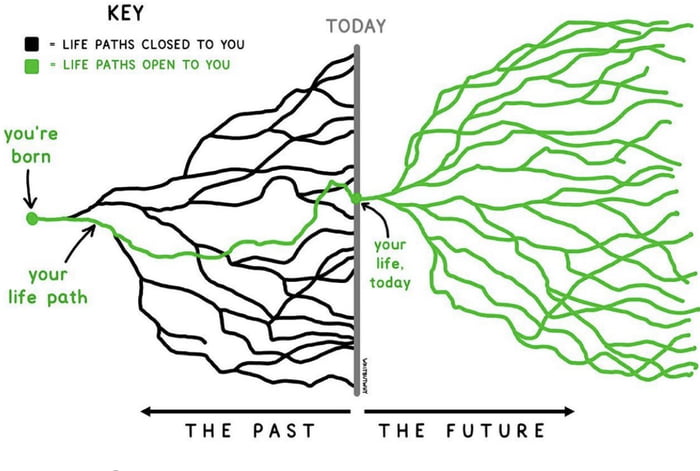
Beyond that simple idea, what I was really trying to find a way to articulate, and to visualize, is that certain places offer you more choices, more branches, more paths, than others. One of the things you can aspire to do, if you value having more choices, is to identify these rich nodes in your life path network and to find ways to get there. Is there a school you need to attend? An organization for whom you need to work or volunteer? A book you need to read?
It goes without saying that few of us can ever know for certain, but it struck me that, with some guidance from elders (like me, like me!) younger people could perhaps position themselves in a way as to maximize open paths. (I hesitate to call them opportunities.)
I never did have this conversation with my daughter, but I have thought about the idea off and on for five or six years now. I keep hoping I will have some great insight, and maybe I will.
On English Departments
The place of English departments has already changed to a large degree, with many faculty simply not aware of it. Undergraduate enrollments are down across the country, perhaps due in part to what has happened here in Louisiana with the outsourcing of freshman composition to high schools. There is yet to be a complete assessment of the enrollment drop, but the rise in focus on STEM education and on “bank-able” careers has certainly not helped. So far, the humanities in general and English departments in particular have not done well in making an argument for pursuing degrees, or at least significant coursework, in their disciplines. The argument that we offer critical thinking skills or advanced writing skills has not lessened the drop in enrollment. (It does not help that we largely leave “critical thinking” and “advanced writing” largely undefined such that neither faculty nor students understand what it is students will take away.)
Few students I have ever known, especially in a place like south Louisiana (where I myself grew up and went to university), entered college planning to major in English. Rather, we were lucky, usually post-composition, to take a general elective early in our college career where we were amazed at the opportunity to think about compelling, complex documents in ways that made us feel our own thinking made a contribution. This, I would argue, is significantly different than many of the lower-level STEM courses where the focus is often on entrainment. One immediate response to the enrollment crunch is to get those faculty who want to attract students into the field into the courses which fulfill general education requirements.
That’s an initial response, but it doesn’t address the larger question of what an English department does in general and what in particular a degree in English is good for? There seems to be a certain bankability in the human, especially the adolescent human, need to express oneself. Socially and culturally, college is often imagined as the last stage in the process of formalized individuation that seems to be one of the missions of educational institutions. It’s where students go to “discover who they are” and to “choose who they are going to be” or “what they are going to do.” (The American cultural machine has slowly ground down the higher ideals of universities to provide generalized intelligence and abilities to specialized ones — no wonder we fear AI; we fear something will take over now that we’ve crippled ourselves.)
Given this socio-cultural focus on individuation, creative writing has risen over the past few decades to have a significant place in English departments. But refining students’ abilities to write poems, short stories, novels, or plays doesn’t prepare them any more for the workplace than does studying or writing about them. Both engage in a lot of hand waving, like an illusionist getting us to pay attention to her left hand while she palms an object in her right hand.
To address this gap between a classical education, which is what an English major remains to a large degree, and a professional education, departments like the one I am in have introduced things like technical writing and/or professional writing, which we sadly promptly ghettoize, much like we do freshman composition and lower-level gen ed courses. We are literally out of touch: we are not in the classrooms where the majority of non-English majors are. That doesn’t have to be a bad thing in as much as there is no argument being made here that the English major should survive, though it is not clear that any department could survive purely as a service department to other disciplines. What I have seen is that it doesn’t take much for business schools to hire business writing faculty or their own business ethics faculty. The same is probably true for the sciences and social sciences.
So we come back to the question of what could an English degree be good for. (Hat tip to Wendell Berry for his inestimable What Are People For?) Like much of the rest of the humanities at all levels of university and advanced courses in the human sciences and sciences, it is good for thinking. Like the rest of the humanities, it’s good for thinking about complex topics that do not arrive with a manifest structure, unlike a chemical compound or economic formations. Rather, the humanities in general, and English in particular, seem to be at their best when they attempt to tackle complex objects whose underlying structure must be teased out. This is what I do when I tackle a collection of conspiracy theories in particular or the idea of conspiracy theories in general. It’s what my colleagues do when they examine a novel or a cluster of novels—or poems or plays or sentences (oh, linguists!).We examine writing in and through more writing. Other disciplines face similar conundrums or limitless halls of mirrors—look no further than mathematics—but they don’t do it with, in, and through writing.
And the ability to write, especially to write on complex subjects, remains a gold standard for advanced democracies. And that’s why English departments, and degrees, remain important to me.
Chronotopes & Text-Worlds
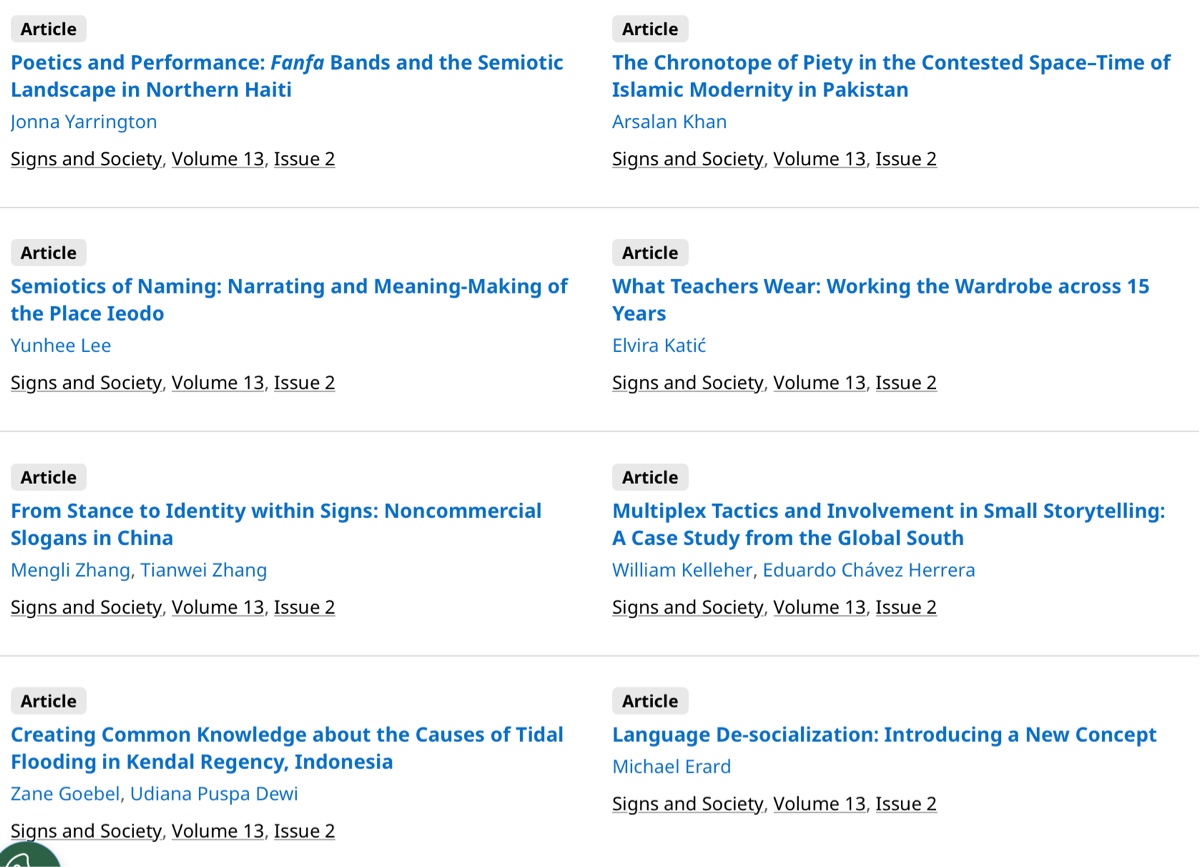
To my mind, there are clear echoes of Mikhail Bakhtin’s chronotopes in text world theory (see Ernestine Lahey’s terrific encapsulation linked below), and so it was good to see that in the most recent issue of Signs and Society there was an article using chronotopes:
Python Movie
The Python documentary is on Youtube.
Increasing Costs of Watching
I am old enough to remember helping my father adjust the directions of the television antenna in order to achieve the clearest picture when watching broadcast television. I remember the large brown box with the giant dial on which he carefully marked the direction the antenna should be facing to receive a particular station’s signal. At the time, there were three broadcasters – CBS, NBC, and ABC – in the VHF spectrum and just one in the UHF, the nascent PBS. As some people who continue to receive broadcast television “over the air” know, reception was free. It was the advertising that paid for what you watched.
At some point in the seventies, most homes changed over to cable reception. While you paid for the service, in return you got a constant, clear signal and you also got additional channels – I think is when the idea of “channels” emerged? – which became known as “super stations” and later became the basis for broadcasters like TBS. (There was a station out of Chicago, but I don’t remember what it was called and I don’t know what became of it.) In the era of cable television, we both paid for television and still got served advertising. We understood that cable was a middle man, a broker if you will, and some of what we were paying for was not only reception but the additional channels. (This is when ESPN got its start?)
And then along came the internet revolution and a lot of us became “cable cutters,” with the idea that we would subscribe directly to broadcasters, who were now reborn as “content providers.” This new model promised an era of better television because the audience would pay for it and we would fewer “suits” mucking about on the content creation side. These new providers, which now included Netflix and Amazon, were going to act like studios, which are themselves a kind of broker, acting as a hinge point between actual content creators and their audiences.
It was a splendid moment. But the suits were not going to stay away for long, and soon they overbought and overbuilt and their “costs” went up and the subscriptions most of us had agreed to were no longer enough and, sigh, that ended in the return of advertising. So, like in the era of cable, we pay to have access to content which is additionally monetized through advertising. And this is true except for Apple TV+ and Disney+, which may be one reason to subscribe to one or the other. (A little pricey to subscribe to both.)
Each service offers a way to “opt out” of receiving ads by paying for a Plus or Premium version of the service, which in the case of PeacockTV, for example, is a 50% increase.
So what? That’s how business works. True. And what that means is that our little household now does what other households do: we sign up, watch what we know we want to watch (and purposeful watching rather than grazing is probably better for us) and then we cancel the subscription, perhaps changing to another subscription in the process.
Mapping Culture with AI
One of the best responses to what AI brings to the table, amidst all the other hand waving or wringing, is Ted Underwood’s observation that we have an opportunity to use the geometries encoded within the models to map culture. Underwood uses a broad brush here, but implicit in his account, I think, is that the kinds of maps we are talking about are localized: perhaps to a given microculture (or speech community) or perhaps to a given genre.
Take for example the conspiracy theory as a genre: what if we took a base-line transformer, or perhaps a more fully kitted out model, and gave it a corpus of conspiracy theories to digest? Could we then lift up the hood of the transformer and see some of the workings for CTs for ourselves? I am particularly curious how such an effort might reveal patterns we had not noticed or even offered us a synopsis which at first glance doesn’t make sense. As Farrell et al note: “the probability distributions of long word sequences are … imperfect representation[s] of language but contain a surprisingly large amount of information about the patterns [they] summarize” (2025:1154). (Hat tip to Underwood for the reference!)
To be fair, Farrell et al are more interested in large scale analytical possibilities. They note, for example, that “such technologies could be used to find patterns in texts and images that crisscross the space of human knowledge and culture” (1155). As someone with more than a passing interest in recent developments in cultural evolution studies, the ability of LLMs to discern such patterns is very exciting, but I think starting small and focused is perhaps the best place to start. The opportunities for a productive tension between algorithmic results and conventional ways of understanding are terrific here.
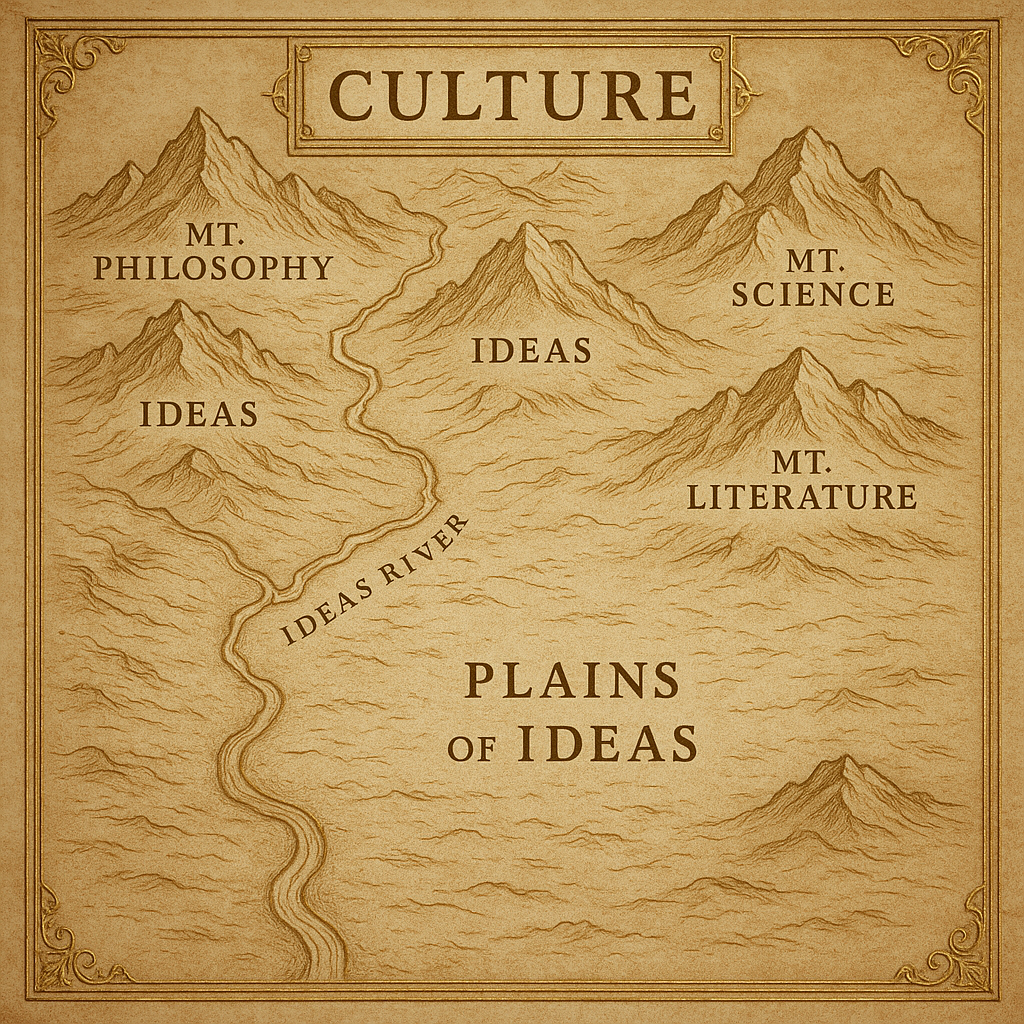
Farrell, Henry et al. 2025. Large AI models are cultural and social technologies. Science 387(1153-1156). DOI:10.1126/science.adt9819.
Just the Comments, Please
If like me you read a lot of manuscripts in Word and then meet with manuscript authors to discuss their work and if like me you prefer to make compelling, constructive comments, then you are left flipping, or scrolling through a manuscript to remind yourself of your comments. To do that, you might want to be able to print those comments. Here’s how to do it:
-
While in the Word document for which you wish to see comments, go to print the document.
-
In the Print dialog box, go to the Microsoft Word option — you may have to click the > next to it to unfold it.
-
Click on the dropdown menu next to Print What: and select List of markup.
Click Print and it will print your comments as well as, sadly, all the changes you’ve made. I tend not to make a lot of editorial changes in a document but, rather, focus on higher-level matters in hopes that, as the topical and methodological kinks get worked out, so too will the grammatical ones.
Running an LLM Locally
I spent a portion of today following Cody Wabiszewski’s guide on how to download and run the Dolphin Llama 3 model. His directions are quite good, but they miss a few things, especially when it comes to setting things up on a Mac. So for those Mac users who want expand the scope of running an LLM locally beyond Apple Intelligence, I suggest the following:
-
Head over to the Ollama website to download one of the available models. Wabiszewski recommends
dolphin-llama3and that’s what I went with. -
You start with the Ollama.app. (I’m not crazy about this, but I wanted the friendliest possible way of doing this because I wanted to make this process reproducible for others … a notion that is completely contradicted by the next step …
-
Once the Ollama app is running, you can then use the terminal to run, in two different tabs!,
ollama serveandollama run dolphin-llama3. (The latter command downloads the dolphin-llama3 model, which is about 5GB. Complete information on the model is available on its Ollama web page.)
Now, there is a slight complication: when I downloaded the Dolphin Llama 3 model, it was not located where any of the posts I read suggested. Instead, I needed to use
locateto find the directory. (If you have not runlocatebefore, you will need to let it build its database, but that does not take long – less than 10 minutes on my M1 MacBook Air with 1TB storage.) Eventually I found it in a hidden directory in my home folder:./ollama. (I would eventually like to move that to an unhidden directory dedicated to models, but I left it there for the time being.)
- Download the AnythingLLM app, install it, and then run it. Create a workspace as directed, then click on the setting gear and then the Chat Settings. If ollama serve is running, you should be able to choose it as an option. There are several clickthroughs for this.
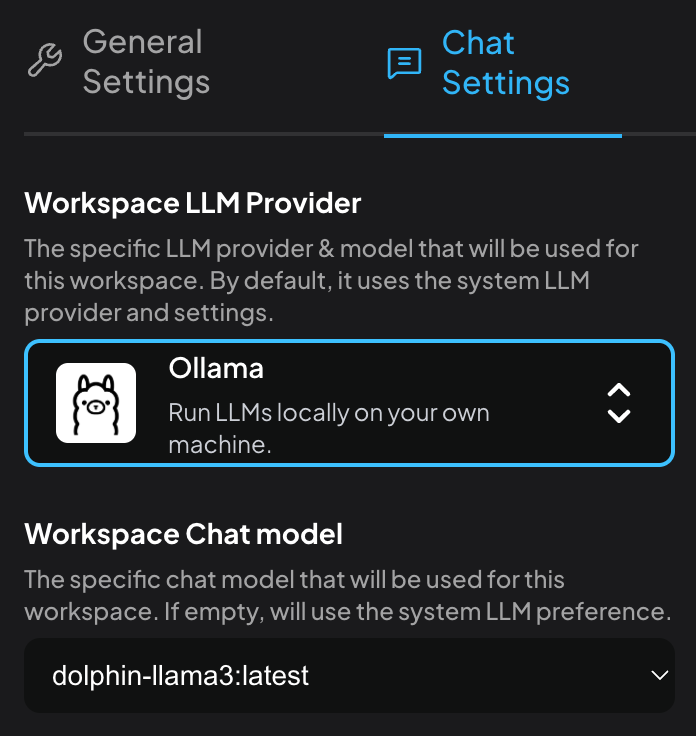
Once this is done, you are able to run an LLM locally. (BTW, this one has no guard rails, so be careful what you ask!)
To see all posts, see the archive.
<!– or search for what you seek:
–>