Story Games
ENGL 370-002 / TuTh 12:30-13:45 / HLG 320
Pr. John Laudun / HLG 356 / laudun@louisiana.edu
Description
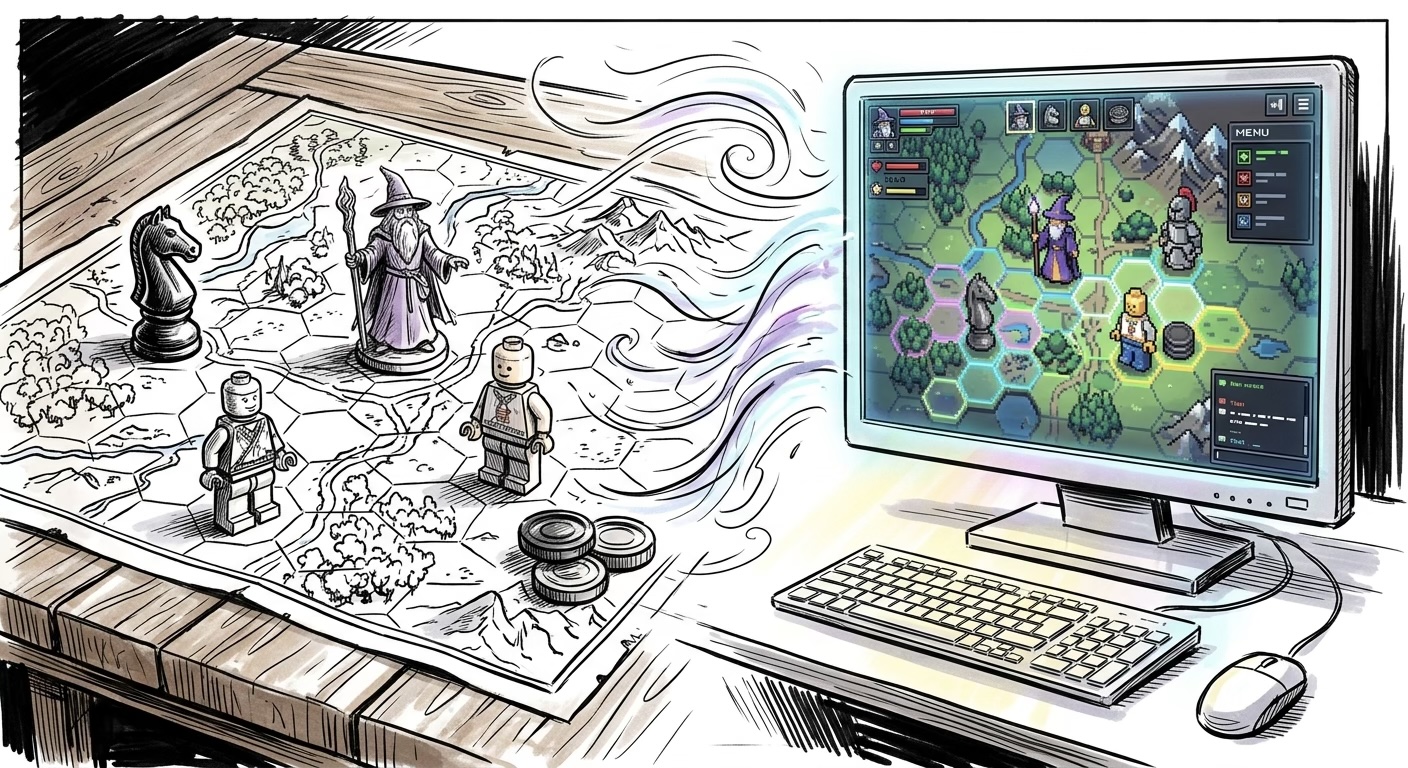
Branching narratives, interactive fiction, text adventures, CYOA (Choose Your Own Adventure) all describe a form of entertainment–be it literary, performed in a group, or in a video game–in which a user is given choices and their choices determine the nature and outcome of the story. This course considers the history of narrative games, from collaborative storytelling in oral cultures to the robust open-world games to cinematic universes in which multiple storylines exist (and sometimes interact). Course inputs include reading analytical–game studies!–and practical essays as well as viewing analytical and practical videos–(warning: these can be long), and of course playing games of various kinds. Course outputs include several short analytical essays as well as the development of a solo TTRPG by mid-semester which can be revised or expanded into a multi-player TTRPG or turned into a sketch for a video game as a final project.
Objectives
This course aims to provide participants with the necessary tools and skills to analyze and to create story/narrative games. To do this, participants will need to master: foundational concepts in narrative and game design, experiment with a variety of game mechanics, engage others collaboratively (and occasionally competitively), document their work both individually and collectively, and be able to present their work to an audience.
We start with TTRPGs because they require clear and effective writing. For those more interested in video games, TTRPGs are a good place place to experiment with game mechanics. (See this 2023 GDC talk.) Everyone builds a solo TTRPG. Everyone.
Course Materials
Textbook
For this iteration of the course, we will be using Skaff et al’s Characteristics of Games. For those interested in video games, Heussner et al’s The Game Narrative Toolbox offers a lot of practical advice and has previously been the textbook for this course. The short of it is this: this is an upper-division course: you will be reading. Buy the book; read the material. Come ready to discuss–as well as to operationalize!
Elias, George Skaff, Richard Garfield, and K. Robert Gutschera. 2012. Characteristics of Games. MIT Press.
Heussner, Tobias, Toiya Kristen Finley, Jennifer Brandes Hepler, and Ann Lemay. 2023. The Game Narrative Toolbox. Focal Press Game Design Workshops.
In addition to the textbook, there are a variety of readings online, including via portals like JSTOR, or under the files tab in our Teams instance.
Hardware
In addition to the textbook, there is also a list of materials:
- Dice: Participants will need a set of die that includes several D6 and at least one each of D8, D12, and D20 (more is better but not required). 16mm and 19mm dies are more adult human friendly, but functionality matters more than size.
- 3 x 5 cards: We will be prototyping, and trialing, first physical and, perhaps later, virtual narrative game forms. Participants need to be able to generate both. While there are pre-cut square and hexagonal game tiles of various sizes, blank playing cards, and a myriad other ready-made materials, access, and willingness to use one’s imagination, cardstock and cardboard are the only things required. (An awful lot can be achieved with 3 x 5 cards.) And, yes, effective, and compelling, game figures can be created out of cardboard cutouts and markers.
- Markers & Scissors: In order to create the cards, tiles, and boards from a variety of materials, participants will also need to have scissors or other cutting implements – please exercise caution and remember to use a cutting mat when working – as well as markers or painting supplies.
Software
- In addition to these physical materials, participants will of course need access to a computer and software. The university provides a license to Office 365. Use of Teams is mandatory, and you might as well use the other apps as well. There is a fair amount of writing in this course, much of it structured, and so familiarity with Word’s outline capabilities and the relationship between outline headings and styles is required. (We will discuss this in class, but you should start familiarizing yourself with this stuff now: your life will be so much easier for it.) PowerPoint can be an interesting platform for interactive fiction with its ability to have clickable links between non-sequential slides, and Excel can be pressed into service as a kind of database or project outline and/or Gantt chart. (If you use the equivalent software elsewhere, familiarize yourself with export options to Office file formats – I prefer Keynote to PowerPoint, but there is no Keynote option on the classroom computer.)
- We will be using network graphs to represent interactive fictions and narrative games. This can be done entirely with note cards, by the way, but you can also create simple diagrams in presentation software like PowerPoint or Keynote. Anything more than a few nodes high/deep quickly becomes about managing readability and not about generating ideas. There are a variety of mind-mapping, as well as diagramming, applications available. Feel free to familiarize yourself with one but you can do an awful lot with Twine. See Resources > Software for more.
Assignments & Grading
It should be noted upfront that the essential sequence of this course is the design and manufacture of a solo TTRPG for the mid-semester project, with the chance to refine it, expand it to a multi-player TTRPG, or convert it to a video RPG as the final project.
More than anything, this course expects and requires that participants be open to new ideas and different kinds of course experiences. This course was first offered in 2024, and it remains exploratory in many ways, always seeking to answer the question: what do participants need to know to think more clearly about stories and games and the media within which the two combine?
Participation (20%) includes all group activities as well as contribution to in- and out-of-class discussions.
Assignments (40%). There are a number of small assignments in this course: in-class activities, quickfire writing, analytical essays, design journals. (This is an English class, of course there is writing. Of course!) Some of the assignments are about developing your overall knowledge of games and narrative, and some are focused on you developing your own game(s). In all cases, this course is about ideation, planning, and execution at a high level thanks to drafting and revision; it is not about surprises and last-minute deadline screeching. You have been warned.
(Solo) TTRPG (20%). Table-Top Role-Playing Games are a great way to “see” the mechanics that underlie computer games and other automated systems.
RPG (20%): Computer Role-Playing Games are what most people think about if they don’t think about Dungeons and Dragons first. As our textbook makes clear, most CRPGs are created by teams for a reason: there’s a lot to the end product. Here, we are prototyping a game, using Twine as the basis: there is a surprising amount of functionality under its hood and it keeps you focused on the essentials of good narrative game design: the critical path and the choices you present the player.
This course has no exams: it is focused on individual and group productivity. If you need an exam to motivate you to learn or to work, this course is not for you.
The Small Print
There is a common set of guidelines/requirements on how to be a participant in a course I facilitate. Read The Essentials. That note is part of a collections of notes I have compiled over the years in response to common questions and needs. Please consult those guides to see if your question already has an answer. (In all cases, my answer there will be better.)
And, sigh, yes, there is an AI policy for this course, and it is quite simple: if you feel the need to use AI to produce materials for this course, then this course is not for you. This class assumes that the participants are committed to their own growth in understanding and practice. Period.
Agenda
Please note that this course follows an agenda, not a schedule. The actual timing of discussions will be determined by the interest, experience, and expertise in the room. Some topics will expand; others will contract. If you are unsure about the date for a particular reading or discussion or assignment, first check Teams to see if an update has been posted and then check with a classmate.
The following are units that have been offered in previous iterations of this course and which may be used again. (A final version of this syllabus will be posted on August 15.)
Foundations
On our first day of class we will need to cover the usual course overview and then set up groups and proceed with the first group assignment. After that, there is your first individual assignment. And that’s all in the first two weeks.
Getting Started with TTRPGs
There are plenty of places to get interesting insights into game design. A short list might include the following, but please be aware that there are a number of channels on Youtube and Discord as well as Substack sites.
- Tabletop Skirmish Games: Make Your Own Tabletop RPG.
- How to Be a Great GM: 7 Things You Should Know When Making Your Own TTRPG.
- Extra Credits: How To Start Your Game Narrative: Design Mechanics First.
Analysis. You are free to choose any TTRPG for your analysis your analytical essay, but I do recommend considering a smaller TTRPG (one whose rule set is less than 100 pages).
Build. The rule set for your TTRPG must be at least 1000 words. It must contain clear directions. It is recommended that you do not require players to have too many particular materials, though it is not unreasonable to require figures. (If you have particular figures in mind and can point people to their 3D print files, then all the better.) Focus on games playable in small spaces (no more than 24 x 24 inches).
If you don’t quite know where to get started with rules, you can always use/adapt one of the open source systems, both of which have Discord communities:
- Shift is a bit expensive, but the core rule set is extensive (160+ pages!).
- 2400 (also 24XX) is free or very inexpensive and offers a variety of adjacent materials.
Resources
Getting Started
- Extra Credit’s advice is not to start with a complete story: How To Start Your Game Narrative: Design Mechanics First. (Note that this is oriented toward VRPGs.)
- Extra Credit also has a video arguing that game writing comes down to Plot, Character, Lore.
- Adapt a game you like. It’s what I did. This works for TTRPGs more than video games.
- Adam Robinson-Yu has a terrific breakdown of what it took to put A Short Hike together: Crafting A Tiny Open World: A Short Hike Postmortem.
Approaches to Play
- The Power of Play: The Unexpected Truth about Play in Nature on Youtube.
- Toddler Brothers Being Silly & Playing Together on YouTube.
-
3 & 5 Year Old Brothers Playing Together on Youtube.
- While “theater of the mind” is an overly dramatic turn of phrase, the idea is fairly compelling, and this description captures what’s at stake in providing readers and players with the feeling of being there: - Elevate Your D&D games with “Theater of the Mind”.
Puzzles
- Dungeon Masterpiece on why RIVEN is a D&D Puzzle Masterclass.
Game Theory
“Game theory” is a field of mathematics. While it is not central to this course, some of you may want to explore it both for ideas for game mechanics but also to anticipate possible problems with mechanics you are considering.
- Martin Osborne’s Introduction to Game Theory is an online book.
- Open Textbook Library has Nordstrom and OregonIntroduction to Game Theory: A Discovery Approach available both online and as a downloadable PDF.
- Coursera has Stanford’s Game Theory class. The claim you can finish it in 17 hours.
- If you want to get a glimpse of game theory before exploring any of the links above, Nicky Case has a fantastic interactive rendition of “The Prisoner’s Dilemma,” Trust. Play the game. Write down two things: (1) Implications of the game theory behind for game design and (2) the implications for life.
Opportunities
- It is too late to enter this year’s Interactive Fiction Competition, but there’s always next year. In the mean time, this year’s entries will be released to the public on September 1.
- malev_minis posted about a community challenge for a One Box Wargame.
- It’s okay if you have no interest in working in the games or literary industries. If fan fiction has proven anything, it’s proven that the boundaries between being an amateur and being a professional have long been blurred. Nathalie Lawhead recently gave a talk essentially arguing that hobby makers are important to the games industry.
- Maybe all you want to do is make games: How to Survive in Gamedev for Eleven Years Without a Hit.
Ideas for Game Mechanics
One of the things you have to do when you create a game is to start building mechanics of play, and those mechanics are almost always quantifications of abilities and skills as inputs and actions as outcomes.
-
Matthew Colville addresses some of the basics of quantification in “Worldbuilding: The Demographics of Capital”. (Capital is the game he was working on.)
- The simple d6 oracle: 6-Yes And, 5-Yes, 4-Yes But, 3-No But, 2-No, 1-No And.
- Incompetech has a grid generator as well as pre-formatted grid PDFs you can print: Grid Paper PDFs. (Feel free to search for “grid generator” to see what else is out there.) Grids are great for maps of all kinds as well as for planning.
- The Crooked Staff Blog offers a wide variety of fantasy and scifi architecture and furniture PDFs that you print, glue onto cardboard or foam core board, and then cut out. It’s impressive.
- Dungeon Scrawl lets you create dungeons simply by clicking and dragging to create corridors and rooms. It’s a lot of fun.
Podcasts/Channels/Conferences
There are a lot of podcasts to follow! Some you listen to and some you watch:
- Critical Roll is the granddaddy of RPG Youtube channels.
- Trevor Devall’s Me, Myself, & Die began as a solo RPG effort but grew into a lot more.
- The Infernal Schoolhouse explores Dungeons and Dragons, retro gaming, and gaming culture.
- Worldbuild with Us has a name that tells you what it’s about.
- The award for TTRPGs is called the Ennies which are given out at GenCon every year.
Interactive Fiction
Teaching and Learning With Interactive Fiction has a lot of resources, including links to famous interactive fictions. (You can download the entire site as a PDF.) There is also the The Interactive Fiction DatabaseAdventures which list interactive fiction and text adventures.
For those interested in writing, interactive fiction there are a lot options in terms of applications that are available. The three below are both free to use and open source. They also have active development and user communities, which means help, advice, and encouragement are never far away. The apps are listed in order of ease-of-use for a beginner. Both Twine and Inky use a plain text markup language which can actually be written in any text editor: Microsoft Visual Studio Code extensions are available for both twee and ink.
- Twine is another piece of open source software for creating interactive fiction / non-linear stories. Twine is based on a markup language that you can write in any text editor – I use , twee, as well as ink (below). You can also download the free Twine editor which has a GUI that allows you create the kinds of visualizations discussed above.
- Ink is a easy-to-understand markup language that has Unity and Unreal compatibility. (See the website for about plugins and compatibility.)
- Inform is open source software for creating interactive fiction. It uses something very close to natural language syntax and makes it easy to draft and then compile a playable text-based game. The website has links not only to the download but also to a variety of useful resources on interactive fiction: writing advice, community forums, and example fictions.
Game Design
- For a one-stop shop for a variety of game development topics, GDC’s YouTube channel is impressive. We watch some of these videos as part of this course.
- In particular, Jurie Horneman’s 2015 session at GDC, “The Design in Narrative Design” is worth the watch.
- The Level Design Book
- Map Crow’s “Draw Your DnD World” is about maps, but it’s also about how you should always orient your fiction/game toward actions your audience/player can take. There’s a lot of good content on his Youtube channel. For example, in “How to Build a Better Dungeon” he thinks through the process of creating a dungeon for an RPG gaming session, which includes important narrative elements like how many encounters to have in a map/session and, just as importantly, what kind of themes or premises do you want running throughout the dungeon session. FTR, Map Crow suggests 4-6 encounters per session with maybe 2 of those being substantial combat encounters. His “Jaquaysing the Dungeon” is useful for thinking about how to enrich the experience of your users-readers-audience.
- Game Design Skills has a Player-Centric Crash Course for those who would like to be (video) game designers.
- Indie Game Clinic’s How (and Why) to Design for Repetition With Variety.
Software
There are a lot of choices for software focused on narrative games. (I chose Twine because it’s easy to get started, if also a bit harder to do more complicated or nuanced things.) Almost all of them are focused on video games for the obvious reason that most TTRPGs just need a word processor and, maybe, an image editor.
- StoryFlow Editor looks interesting, and powerful (and complex), and it’s available on both Steam and Itch.io.
- Articy claims that “integrating content from your narrative design tool into your game has never been easier. Hundreds of quests, thousands of items, countless lines of dialogue - all in your game with one click.”
- Celtx offers “screen writing, story development, and production tools for film & TV, and interactive media.”
- YarnSpinner describes itself as “Everything you need to create compelling dialogue and branching narratives, with full documentation and community support.” It has integrations for Unity, Godot, and Unreal engines.
Game Narratives
Procedurally-Generated
-
[Featured Blog Supporting game design with evolutionary algorithms](https://www.gamedeveloper.com/design/supporting-game-design-with-evolutionary-algorithms)
AI
At some point, we have to deal with AI. It’s even come for TTRPGs: Dungeons Deep.